

You probably spend a lot of time thinking about your decisions, your career, your finances, your health, your marriage, and every goal you’re working toward, and most of us assume those decisions are ours alone.
They aren’t.
The single strongest influence on your future has nothing to do with your intelligence, your motivation, or even your work ethic. It’s the people you spend the most time with.
That sounds almost too simple, and it’s also one of the most overlooked truths about how people work.
We Become What Feels Normal
Your brain keeps asking one question on repeat, what’s normal here, and the moment it gets an answer, it adjusts without asking your permission.
Surround yourself with people who exercise, read, keep their commitments, and talk about the future they’re building, and all of that starts feeling ordinary within a matter of weeks. Surround yourself with people who complain about work, dodge responsibility, settle for less, and make excuses, and that starts feeling just as ordinary, just as fast.
Most of this happens well below conscious thought. Nobody wakes up and decides to lower their standards, or raise them, we just adapt to whatever’s around us. That’s one of the reasons your friendships shape so much of your life.
Your Friends Shape More Than Your Schedule
Friends don’t just influence what you do on the weekends. They influence what you believe is possible.
Spend enough time around entrepreneurs, and starting a business begins to feel realistic. Spend enough time around people who invest wisely, and saving money starts making sense. Spend enough time around people who prioritize fitness, and taking care of your health becomes part of your identity.
The opposite holds too. Surround yourself with people who believe success is impossible, growth is pointless, or everyone else is the problem, and those ideas seep into your own thinking whether you invited them in or not.
Nobody sits you down and teaches you any of it directly, normal is just contagious, and you catch it by proximity.
Children Learn This Even Faster
Adults have years of experience to push back against unhealthy influence. Children don’t.
When kids find a group where they belong, they start adopting that group’s attitudes, priorities, and behaviors almost immediately. That’s just how friendship works. Belonging sits close to the center of what every human being needs.
Parents get concerned about a child’s friends before they get concerned about the child’s behavior, and there’s a real reason for that. They’re looking upstream. The behavior they’re seeing tomorrow often begins with the friendships forming today.
Teaching kids how to choose their friends is really about teaching them how to choose an environment, not about controlling who they hang out with.
The Better Question
Most of us ask whether somebody is a nice person, which is a fine place to start, but it stops short of the real question.
The better question is this one, who am I becoming because this person is in my life? Do they encourage responsibility or excuses? Do they make honesty easier or harder? Do they challenge you to grow, or make staying comfortable feel acceptable?
The people closest to you become part of the environment your brain adapts to, every single day, whether you’re twelve or fifty-two.
Choose Your Circle Carefully
This was never about only keeping successful friends, or cutting off anyone who’s struggling. Healthy friendships get built on direction, not on achievement.
The people who influence you most for the better are usually the ones already moving toward something worthwhile, the ones who value integrity, take responsibility, encourage growth, and celebrate your progress instead of mocking it. Those are the people who raise everyone’s standard just by being in the room, and they never once announce they’re doing it.
Choose those people carefully. Then work to become one yourself.
The Friend Effect
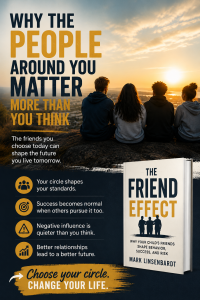
The Friend Effect goes much deeper into all of this. In it, I get into why friendships have such heavy influence over a child’s behavior, confidence, decision making, and future success, and more than that, I show you how to teach the skill of choosing healthy friendships before peer influence turns into a problem.
The goal was always to help your child develop the judgment to choose well on their own, not to hand-pick their friends for them. That’s a skill they’ll use for the rest of their lives.