
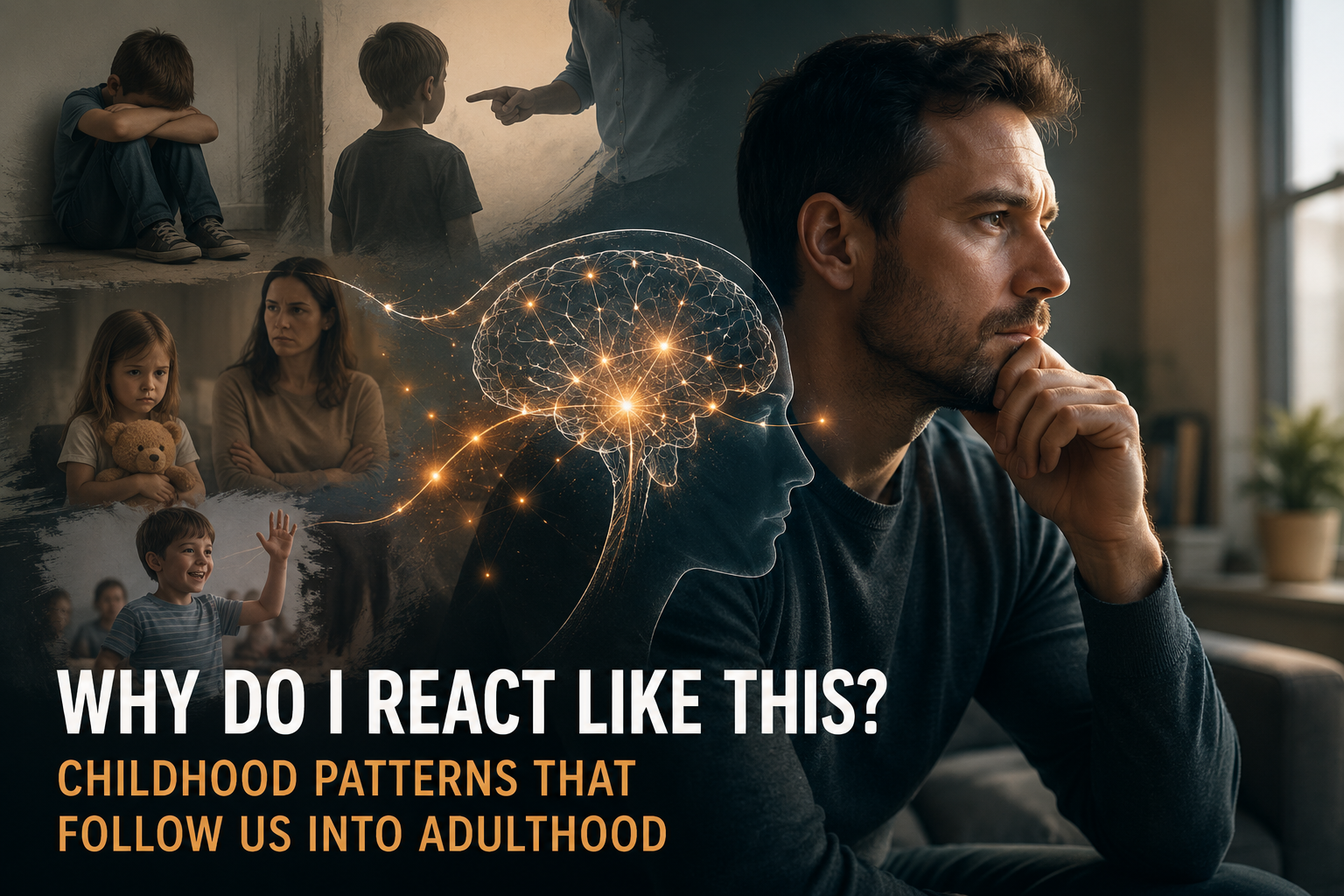
 Have you ever caught yourself saying, “I don’t know why I reacted that way”?
Maybe it was a disagreement with your spouse that escalated faster than it should have, or criticism at work that felt more personal than it deserved, or you caught yourself shutting down, getting defensive, people pleasing, trying to control every detail of a situation before you’d even realized you were doing it.
Most of us assume these reactions are just part of our personality. I’ve come to believe they’re something else entirely.
For years I’ve studied how brains develop, how family systems shape behavior, and why the strategies we learned as kids so often follow us straight into adulthood, and the discovery that surprised me most is that your strongest emotional reactions are usually about something that happened a long time before today.
They’re old solutions showing up in new situations. Understanding that changes everything.
Your Childhood Brain Was Already Solving Problems
Every child starts out with the same basic objective, figuring out how to survive, physically and emotionally both.
How do I get comfort? How do I avoid conflict? How do I earn approval? How do I stay connected to the people I depend on?
Your brain was constantly testing things out, and every interaction taught it something. If speaking up brought comfort, speaking up became a strategy. If staying quiet prevented conflict, silence became a strategy. If making people laugh cut the tension, humor became a strategy, and if blaming somebody else dodged the punishment, your brain filed that away too.
Your brain judged the whole thing by a single question, did this work? A yes saved the program for later, no matter what it cost you down the line, and health was never part of the equation.
Repetition Turns Behavior Into an Automatic Reaction
Think about riding a bike. At first you have to think about everything at once, balance, steering, pedaling, braking, and it feels like way too much information for one body to track. Eventually all of it drops below the level of thought. The behavior goes automatic.
Your emotional reactions develop exactly the same way. The more often you respond a certain way, the stronger that pathway gets, and eventually the reaction fires before you’ve consciously decided anything at all.
Somebody raises their voice, and you’re defensive before you’ve caught up to why. Somebody disappoints you, and you’re already braced for abandonment. Somebody disagrees with you, and it hits like a personal attack.
From the outside, it looks sudden. Inside your brain, it’s about as well practiced as anything you do.
Why Adult Problems Often Have Childhood Roots
People misunderstand this part constantly. Looking back at your childhood was never about assigning blame, it’s about understanding the design. Your childhood was simply the environment where your brain learned its first operating system.
Maybe your family talked openly about things, maybe conflict got avoided instead, maybe emotions weren’t exactly welcome, maybe achievement is what earned you love, maybe perfection felt like the only safe place to stand. Whatever environment surrounded you became the training ground for how you learned to navigate relationships at all.
Those early programs never update themselves just because life changed around them. What protected you at seven can end up costing you plenty at forty, and unless you go back and take a real look at it, your brain keeps using the same old software regardless.
Your Brain Prefers Familiar Over Healthy
Something strange happens when your brain is given a choice between what’s best and what’s familiar. It picks familiar, almost every time.
That’s why people stay in relationships that are hurting them, why the same argument shows up in marriage after marriage, why some people spend years chasing approval from somebody who was never going to give it. The familiarity itself feels safe because your brain has seen it before, even when what it’s seen before keeps costing you.
This is how learning works, plain wiring, nothing more, your brain reaching for certainty over uncertainty, sometimes even when the certain thing is the one that hurts.
Emotional Triggers Are Usually About the Past
You’ve probably noticed two people can live through the exact same moment and walk away with two totally different reactions. One person hears constructive criticism and thinks, I can improve. Another hears the very same words and feels flattened by them. The criticism was identical. The meaning each brain attached to it was the whole difference.
Your brain rarely reacts only to what’s happening in front of you. It reacts to whatever today reminds it of. A spouse forgetting an anniversary might read as simple forgetfulness for one person. For somebody whose childhood taught them they came second, the exact same moment can strike as rejection. A delayed text can mean nothing to one person and trigger real fear of abandonment in somebody else. The present keeps activating the past.
Awareness Creates Freedom
Automatic and permanent are two completely different things, and that’s the encouraging part. You’ve got one real gift built into you for exactly this kind of moment, the ability to watch yourself from a small distance while it’s happening. The second you spot the pattern, you’ve already opened up space between the trigger and the reaction.
Instead of asking why am I like this, you start asking different questions. When did I learn this? What problem was this solving for me at the time? Does it still serve me now? Those questions are what interrupt the autopilot and let your thinking brain climb back into the driver’s seat.
The old reaction can still show up plenty of times before it fully lets go. What changes first is that you can finally see it coming.
New Patterns Require Practice
Plenty of people assume insight alone is enough to change behavior, and it almost never is. Knowing why you react is a completely different skill from reacting differently in the moment. Change itself comes through repetition, not realization.
The old pathways got strong through years of practice, and the healthier ones need exactly the same investment. That might mean pausing half a second before you respond, owning your part in a disagreement, choosing curiosity over defensiveness, listening before you start building your rebuttal in your head, admitting flat out when you were wrong.
Each small decision starts strengthening a different pathway, and eventually the new response feels more natural than the old one ever did. Your brain stays adaptable for as long as you’re alive, and that might be the most hopeful thing neuroscience has handed us yet.
You’re Not Stuck
If you recognized yourself somewhere in this piece, stay with it, plenty of us are walking around with patterns we picked up somewhere along the way. The goal was always to understand your past well enough that it stops steering your future.
The healthiest people you know still built these same strategies as kids. What sets them apart is that they got honest about which ones they’re still using. Awareness leads to better choices, better choices turn into better habits, and better habits add up, slowly, into a different life. That journey starts with understanding yourself, not with trying to change somebody else.
You weren’t broken by any of this, you were a kid who needed to survive, and you found strategies that worked well enough to keep for the next thirty years. The real work now is deciding which of those strategies still deserve the job, and which ones are just old furniture nobody’s bothered to move in decades. What you do with that decision is the only part of this story still yours to write.
The Child in Charge goes a lot deeper into exactly this, how childhood survival strategies turn into adult behavior patterns, why they keep showing up long after you need them, and what it takes to work with them instead of against them. It leans on real research in brain development, psychology, and family systems, and it’s written to be used, reading it is only where it starts.