
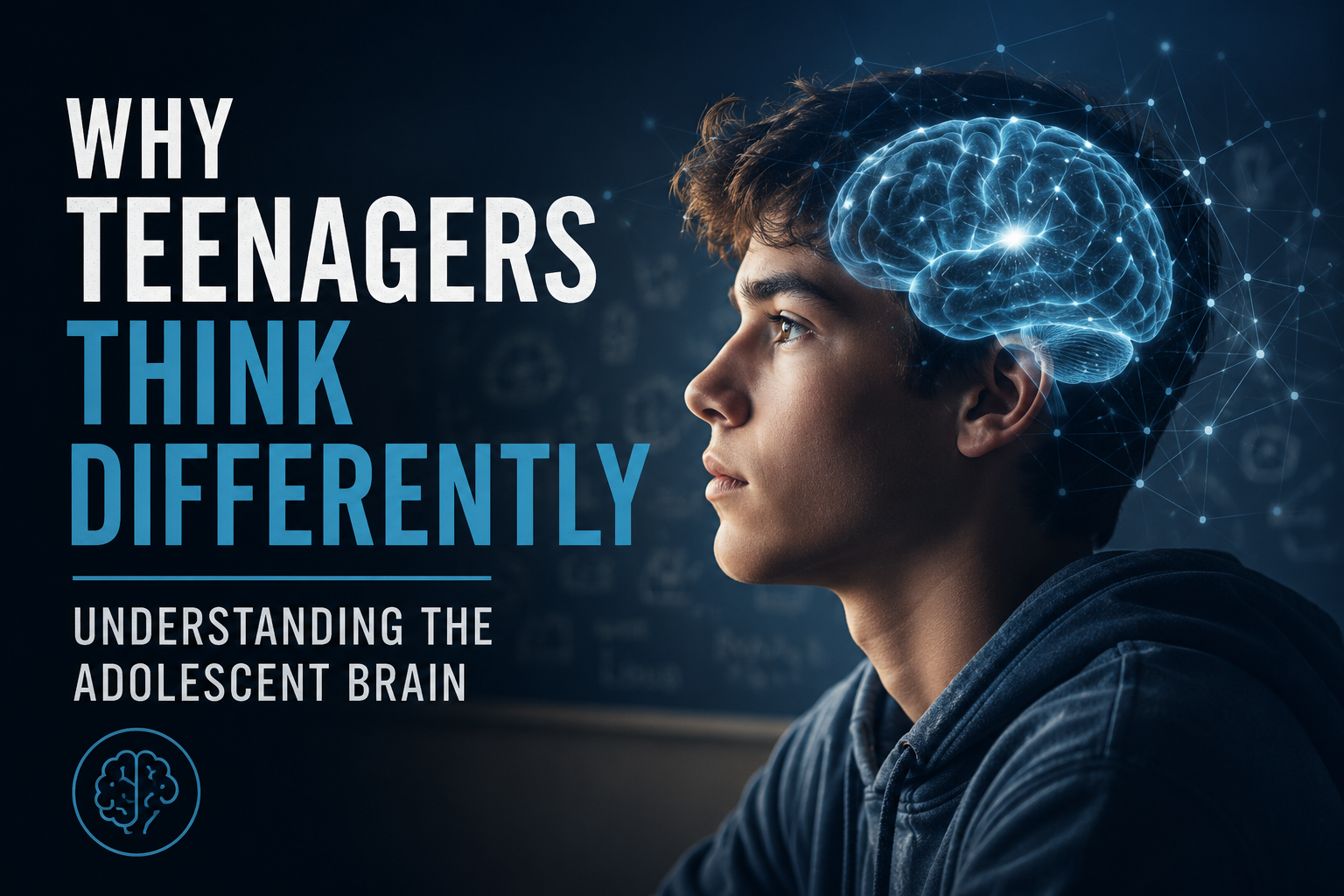
If you’ve ever looked at your teenager and wondered, “Who is this kid?” you’re not alone.
One year they seem thoughtful, cooperative, and easy to talk to. The next they’re taking risks that make no sense, arguing over things that used to slide right past them, and reacting emotionally to situations that seem relatively minor.
Most parents assume something has gone wrong. In reality, something has changed.
Your teenager’s brain is moving through one of the biggest developmental stretches in an entire human life. Bad behavior still gets addressed the same as always, understanding the stretch just changes how you address it, and why parenting a teenager calls for a different approach than parenting a child ever did.
Once you understand what’s happening under the hood, many of the daily battles begin to make a lot more sense.
The Brain Gets an Upgrade
Most people think brain development is largely finished by elementary school. It isn’t.
Early childhood is an incredible stretch of growth, but adolescence launches a second major wave of development. Your teenager’s brain starts strengthening key neural pathways, getting more efficient, and reorganizing itself for adulthood.
Think of it like upgrading a computer, the hardware getting dramatically more powerful while most of the software still installed on it was written years earlier, back in childhood.
That mismatch explains many of the frustrations families run into during the teenage years.
A Bigger Engine Than Brakes
The simplest way to understand the teenage brain comes down to this, the emotional systems mature well before the judgment systems do.
The parts of your teenager’s brain handling emotion, reward, social acceptance, and excitement light up hard during adolescence, while the parts responsible for planning, impulse control, weighing consequences, and long-term decisions keep developing well into the twenties.
Imagine handing somebody a sports car with race tires bolted on, but only half a braking system installed.
The engine is doing exactly what it’s supposed to do. The brakes just haven’t caught up yet.
That’s why a teenager can know exactly what the right call was, five minutes after making the wrong one.
Why Emotions Suddenly Feel Bigger
Parents often read this as drama. From the teenager’s side, this is the whole world, full stop.
Social situations become enormously important during adolescence. Acceptance, rejection, friendships, embarrassment, and belonging hit noticeably harder than they did a few years earlier. Your teenager’s brain is paying extraordinary attention to these experiences, because this whole stage of development exists to prepare them for an independent adult life.
Some of those reactions still miss the mark, and that stays true no matter how big the feeling is. What’s real is the intensity underneath, even when the trigger looks small to an adult.
Why Logic Loses in the Moment
Plenty of parents discover that perfectly reasonable explanations just stop working. You explain the consequences, your teenager agrees, and a week later they do the exact same thing again.
Call it a timing problem before you call it rebellion, because that’s usually what’s really going on. When emotion is driving the moment, the logical parts of your teenager’s brain get a lot less say than most parents expect. By the time calm returns, your teenager can often explain exactly what they should have done differently.
Your teenager may know exactly what the right thing to do is, and when emotion takes the wheel, good judgment simply lags behind it. That’s why a calm conversation afterward usually teaches far more than any lecture delivered in the middle of an argument.
The Brain Learns Through Experience
Your teenager’s brain is remarkably adaptable. Every success, every failure, every conversation, relationship, and consequence strengthens certain neural pathways while letting others fade, and that process is exactly what makes repeated behavior easier and more automatic over time.
That’s encouraging news. Healthy habits become easier with practice. So do unhealthy ones.
Every interaction at home is teaching something, whether we intend it to or not.
Parents Are Still the Bigger Influence
A lot of parents believe their influence disappears once their kid becomes a teenager. It changes shape instead, and it never really disappears.
Teenagers naturally start looking outside the family as they get ready for adulthood, and friends, independence, and privacy all start taking up more space than they used to.
Parents sometimes read this as rejection. It usually isn’t.
The family stops being the only influence, but it’s still one of the strongest ones in the room. Consistent expectations, calm conversations, healthy boundaries, and strong relationships keep shaping development throughout adolescence.
A Growth Window, Not Forever
The teenage years hold more than survival in them, they hold one of the richest growth windows a person ever gets.
Your teenager’s brain is exceptionally capable of learning during this stretch. Character, emotional regulation, responsibility, communication, and decision making can all improve dramatically during these years.
That’s exactly why understanding the science is worth the effort. When parents stop reading every behavior as defiance and start recognizing the development driving it, they respond differently, and teenagers usually respond differently right back.
Understanding still leaves accountability fully in place, it just delivers that accountability in a way the developing brain can work with.
Final Thoughts
They’re under construction, not broken.
Their brains are reorganizing at extraordinary speed while they’re also trying to navigate friendships, identity, independence, school, family expectations, and a world that keeps asking them to make adult decisions before adult brain development is even finished.
Parents who understand that process gain something incredibly valuable.
Perspective.
Instead of asking what’s wrong with my teenager, they start asking what does my teenager’s brain need from me right now, and that single change moves more than most families expect.
The Neurons and Narratives Bundle
The complete picture lives in the Neurons & Narratives bundle.
Neurons & Narratives: Parent Edition explains what’s happening inside your teenager’s brain, why family dynamics change during adolescence, and how parents can work with the developing brain instead of fighting against it.
Neurons & Narratives: Teen Edition presents the same science directly to teenagers in language they can understand, helping them recognize what’s happening inside their own minds while building greater responsibility, self-awareness, and better decision-making.
The Neurons & Narratives Family Workbook helps parents and teens put these ideas into practice together through guided discussions, reflection exercises, and practical activities that turn understanding into lasting change.
Together, these three resources give your family a shared language for understanding the adolescent brain, improving communication, reducing unnecessary conflict, and building stronger relationships during one of the most pivotal stretches of their entire development.