
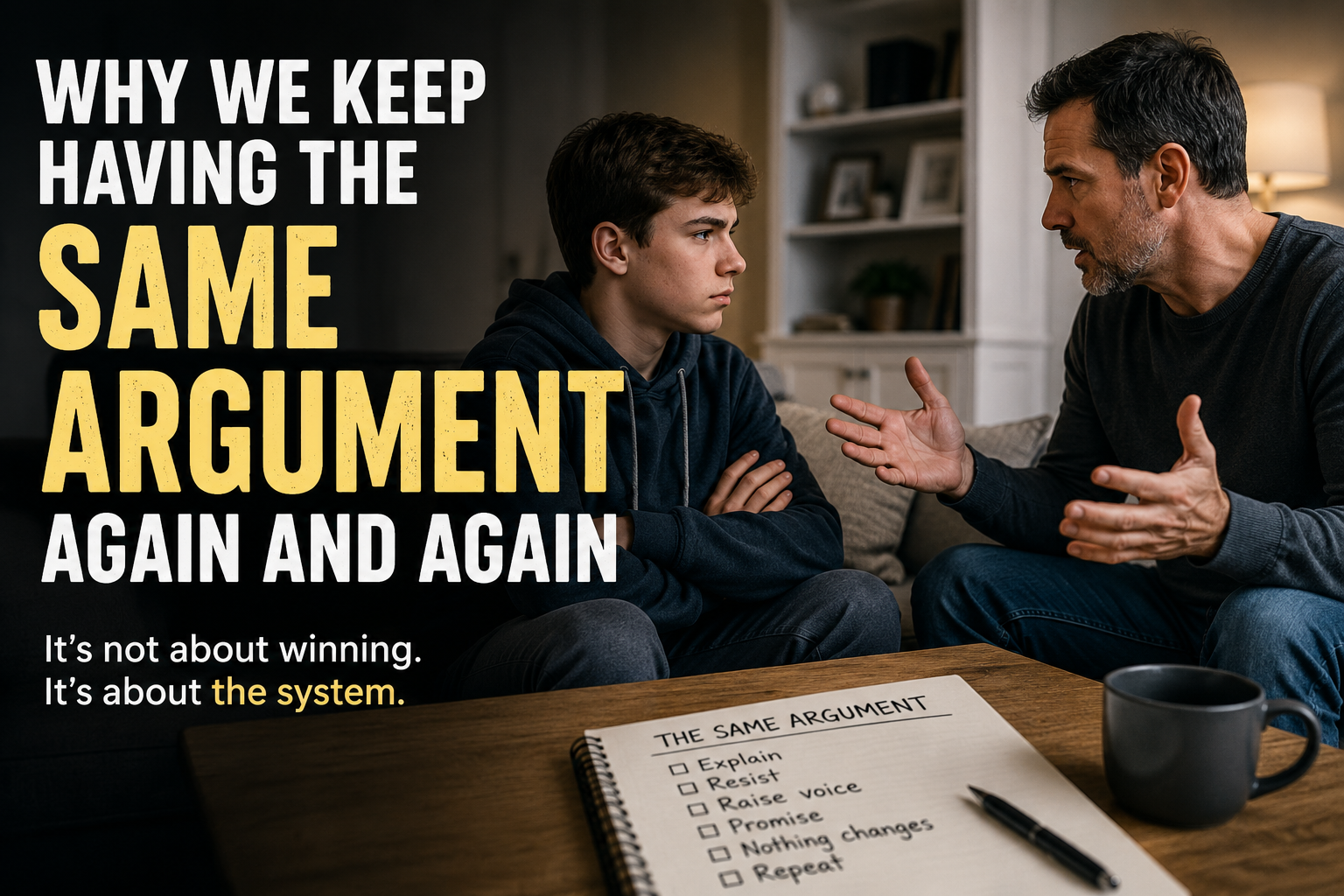
If you’ve had the same argument with your teenager ten times, the problem probably isn’t the topic.
It might be the phone today, chores tomorrow, curfew on Friday, and grades next week. The subjects change, but somehow the conversation always feels familiar. You explain. They resist. You repeat yourself. They promise, and then nothing changes, and a few days later you’re right back where you started.
Most parents assume they’re dealing with a stubborn teenager. I think they’re usually dealing with a broken system.
You’re Solving the Wrong Problem
When families get stuck, they tend to focus on behavior.
“How do I get my teenager to clean their room?”
“How do I stop the constant arguments?”
“How do I get them to keep their word?”
Those are reasonable questions, but they all assume the behavior itself is the problem, when more often the behavior is just revealing it.
Imagine your kitchen faucet leaks every day. You can wipe up the water every morning, but if you never fix the pipe, you’ll be cleaning up the same puddle forever.
Many family arguments work exactly the same way.
The conversation keeps failing for a reason that has nothing to do with the words you’re choosing. It’s failing because your family is asking conversations to do a job conversations were never built to do.
Memory Is a Terrible Place to Store Agreements
Think about how most family rules are created.
Somebody gets home late.
A phone stays out all night.
Homework stays half-done.
An argument follows, everyone eventually calms down, and an agreement gets made.
Until next time.
The problem is that spoken agreements depend on memory.
Memory is flexible.
Stress changes what we remember.
Time changes what we remember.
Emotion changes what we remember.
Parents often remember the agreement as a firm commitment.
Teenagers often remember it as a discussion.
Neither person is necessarily lying. They’re remembering different versions of the same conversation.
Now you’re no longer arguing about the original issue. You’re arguing about what was agreed upon in the first place.
The Argument Becomes the System
Parents rarely notice this part. Every repeated interaction teaches something.
If every rule eventually becomes a negotiation, your teenager learns that rules are negotiable.
If enough resistance eventually wears you down, your teenager learns that persistence changes outcomes.
If consequences sometimes happen and sometimes don’t, your teenager learns to gamble.
They’re not necessarily trying to manipulate you. They’re learning how your household works.
Children and teenagers are exceptional students of patterns. They pay far more attention to what consistently happens than to what is occasionally said. Every repeated interaction becomes another lesson.
Why Nothing Ever Changes
Let’s say you remind your teenager to unload the dishwasher, they say they’ll do it later, and an hour goes by before you remind them again, at which point they’re frustrated because you keep asking and you’re frustrated because they haven’t done it. By bedtime you’ve both forgotten about the dishwasher entirely and you’re arguing about tone, respect, attitude, and fairness instead. Tomorrow, the dishwasher is full again.
Notice what never changed.
The system.
You relied on reminders, they relied on delaying, and eventually somebody got emotional, at which point the original task disappeared underneath the conflict entirely.
Once that pattern repeats enough times, both of your brains begin expecting it. The argument starts feeling inevitable.
Systems Beat Willpower
Parents often believe they just need to be more consistent, and consistency does count for something, but consistency without any structure underneath it is exhausting. If every decision requires fresh energy, fresh emotion, and fresh determination, eventually everyone gets tired. Good systems reduce the number of decisions you have to make.
Think about seat belts. Most of us don’t negotiate whether we wear one today, we simply buckle it because the expectation already exists.
The best family systems work the same way.
Expectations are clear.
Responsibilities are known.
Consequences are predictable.
The conversation becomes much shorter because everyone already understands the process.
Remove the Negotiation
One of the biggest changes a family can make is separating the agreement from the moment of conflict.
Don’t decide consequences while you’re angry.
Don’t negotiate rules after they’ve already been broken.
Don’t create expectations in the middle of frustration.
Have those conversations beforehand. When expectations are established during calm moments, nobody has to invent solutions under pressure. Pressure rarely produces wisdom. It usually produces improvisation.
Calm Parents Make Better Decisions
When emotions rise, both parents and teenagers get more reactive, and nobody listens particularly well while they’re busy defending themselves. That’s exactly why timing counts for so much.
The real goal was never winning arguments. The goal is building a family where fewer arguments are necessary in the first place. Those are very different goals. Winning today’s argument may feel satisfying. Building a system that prevents next week’s argument is far more valuable.
Ask a Better Question
Instead of asking how do I win this argument, try asking what about our system keeps creating this argument in the first place. That single question changes everything. It changes where your attention goes, away from personalities and toward patterns.
Away from blame and toward design.
Away from today’s frustration and toward tomorrow’s solution.
Final Thoughts
Most recurring family arguments happen for reasons that have nothing to do with somebody being bad, lazy, disrespectful, or impossible. They’re happening because families slide into systems they never intentionally built in the first place.
The good news is that systems can be redesigned. When expectations become clear, agreements become visible, and everyone understands what happens next, conflict often shrinks dramatically.
The environment they’re operating in changed. That’s the real difference, and it has nothing to do with your teenager suddenly becoming a different person. When the system changes, behavior usually follows right along with it.
If your family keeps having the same argument, stop trying to improve the argument. Improve the system.
Contracts Not Conflict
Contracts Not Conflict shows you how to replace repeated arguments with clear, written agreements that build accountability and cut down conflict instead of just delaying it. Instead of renegotiating the same rules over and over, you’ll learn how to set expectations everyone understands before the conflict ever starts.
If you’re tired of repeating yourself and ready for a calmer home, Contracts Not Conflict gives you a practical framework you can start using immediately.