
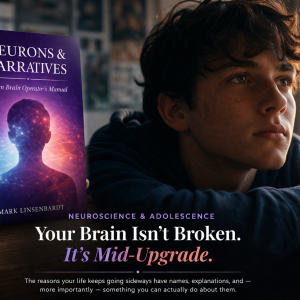
Something is happening in your brain that you didn’t choose. It was built from everything that happened to you before you had any say in how it got designed. And right now, while you are still in your teens, that software is running on completely new hardware that showed up without a manual or a warning.
That’s not just a metaphor. It’s neuroscience. Understanding it changes everything about why the same problems keep showing up in your life.
Take Marcus. At fourteen, he had a complete and total explanation for why his life was the way it was, and that explanation never once included Marcus.
His stepdad was a jerk. His teacher had it out for him. His mom always took everyone else’s side. His biological father kept canceling plans.
Every time something went wrong, the story got updated. Marcus moved on without any idea there was a problem. He wasn’t wrong that Ms. Patterson had preferences, or that his stepdad sometimes pushed when he should have backed off. His brain found real pieces of real evidence, built a pretty solid case on them, and skipped right over the third piece: Marcus had written the essay the night before it was due and hadn’t read a single word afterward.
The story in his head did all the work, and for Marcus, it was just plain and simple truth.
The Lawyer Your Brain Hired Without Asking You
Your brain has a lawyer. It works every hour of every day, and its only job is to protect the client – which is you.
This lawyer doesn’t care about truth or fairness or whether you were actually right or wrong. When something good happens, the lawyer is there immediately, documenting evidence of how capable you are. When something bad happens, it jumps into action: evidence that helps you gets highlighted, evidence that hurts you gets buried, your role in the situation gets smaller, the other person’s role gets bigger. Then the lawyer hands you the finished case labeled: “here’s what really happened.”
You believe it. Of course you believe it, your own brain built it.
“Your brain doesn’t search for truth. It searches for proof that the story it already has is correct.”
This isn’t stupidity or pride. It’s efficiency. For most of human history, being seen as the problem: the liability, the one who couldn’t be trusted, was super dangerous. People who got pushed out of the group didn’t survive. So the brain developed a standing defense: never be the villain in your own story.
Here’s the thing, though. The story that protects your feelings today has a cost that comes later, and your brain has no system for tracking that cost.
The Program Running Without You
There’s a difference between something you’re doing and something that’s happening automatically.
When you decide to do something, when you make a choice consciously, in that moment, that’s you. When a program runs based on conditions your brain set up years ago, before you had any say in how it got designed, that’s the autopilot. That’s a program running.
Think about learning to ride a bike. The first time, you were thinking about every single thing at once. But every time you practiced, the pathway in your brain got a little faster, a little more automatic, until eventually you just got on and rode. Your brain had paved a road for it.
Your responses to hard situations got built the same way. Deflection is a program. So is silence, humor, withdrawal, anger, shutting down. These aren’t personality traits, they’re solutions your brain found, tested against real problems, and decided were worth keeping. The brain doesn’t evaluate whether a solution is healthy or likely to work in ten years. It only asks one question: did it work? If yes, keep it.
“You didn’t write the program. It got written from your experience, back when you were a kid, mostly in situations you didn’t choose, around people you never picked.”
By the time you’re a teenager, a lot of those pathways are established and well-coated. They fire off before you think, before you have a chance to choose anything else. That’s how brains are built. Every brain, including your parents’.
Then the Upgrade
Around age twelve or thirteen, your brain went through one of the most significant structural changes of your entire life. This isn’t puberty either, though puberty was happening at the same time and likely the two are tied together. This is something different: it’s a massive reorganization of how your brain is wired and what it prioritizes.
The limbic system, the part that handles emotion, status, social connection, risk, and reward, got a major upgrade in power and sensitivity. It became louder, faster, and more influential over your behavior. At the same time, the prefrontal cortex, which is the part responsible for consequences, long-term thinking, and impulse control is developing much more slowly. It won’t finish developing until your mid-twenties.
So at twelve or thirteen, you were handed a significantly more powerful emotional engine, but the brakes were still being installed.
This is also why getting corrected feels sharp in a way it didn’t when you were younger. When a teacher says “redo this,” the upgraded brain can hear something more like “you aren’t good enough.” When a parent says “clean your room,” the upgraded brain might translate that into “I don’t trust you.”
The original input and the meaning your brain assigns can be completely different things. This happens faster than thinking, before you have any chance to check the translation.
The defiance you feel toward authority? That’s the upgrade working correctly. It’s not a malfunction. It’s not you becoming a worse person. Your brain is biologically preparing you for independence, teaching you to evaluate authority rather than just obey it. Those are really good questions your brain is asking. The problem is they start being asked at thirteen, when you don’t yet have the judgment or emotional regulation to answer them well.
Why Nobody Told You Any of This
Here’s something that matters: your parents probably don’t know about the upgrade either.
Most parents stopped updating their parenting model around the time you were eight or nine. That was the last major recalibration on parenting. the point where they figured out what worked with you. Then the upgrade hit you at twelve or thirteen, and suddenly the version that worked on the nine-year-old you is running on a brain that has been fundamentally restructured.
From their side, it can feel like you changed overnight and became someone they don’t recognize. From your side, it can feel like they’re treating you like a child even though you’re clearly not. Both things are accurate. The biology just ran on schedule without sending anyone a little note to say so.
Traditional cultures understood this better than ours does. For thousands of years, almost every society had a formal transition ritual at adolescence. It was usually something difficult, something that required real ability, with a clear before and after. The community acknowledged the upgrade. The brain got the signal it was biologically looking for: the questions of capability and worth had been answered.
We don’t have that anymore. What we have instead is a long, undefined middle period where the drive for independence is fully activated but the legitimate pathway to it is unclear. The upgrade happens on schedule. But the test is missing, and the brain, which was built expecting to run the independence drive through a structured challenge, just keeps on running it, waiting for acknowledgement that never comes.
What All of This Costs
A story that protects your feelings today has a real cost that shows up later. and the cost is always delayed, but your brain was never designed to know that.
Two students fail the same test. Student one thinks: “The teacher is unfair.” Student two thinks: “I didn’t study right.” Student one keeps their pride intact and doesn’t change anything. Student two has a bad moment, owns it, studies differently, and the next test goes better. Behind the scenes a track record gets built that Student one will never build.
Adults around you recognize this even when they don’t say it. Teachers stop going to bat for students whose story is always someone else’s fault. Parents start managing rather than trusting. Friends learn to agree with you or say nothing. You end up surrounded by people who either go along with the story or keep their distance.
That’s the mechanism. The story creates behavior, the behavior produces a response, the response gets filed as evidence, the story strengthens. The world just gets a little smaller, one semester at a time, in ways nobody is tracking.
— ✦ —
The Good News
Here’s what this book is not going to do: tell you your feelings are wrong. When someone is truly unfair to you, that’s real. When something isn’t your fault, that’s real. The problem isn’t the story. The problem is the story running without you knowing it’s just a story.
Your brain is right sometimes. The program reads the situation correctly, the story it builds is accurate. But other times it gets it completely wrong, and your brain can’t tell you which times are which. It just runs a program and hands you a result it thinks is the truth.
What changes things is knowing that. When these programs feel like personality, like just who you are, like obvious truth about how the world works. That feeling is real to you. It’s also the program talking. The minute you can see a program as a program instead of as reality, something opens up. You can look at it. You can ask if this thing you’re doing is still working for the situations you’re actually in now.
“You are not broken. You are mid-upgrade. Those are different things entirely.”
The window you’re in right now is the specific one designed for exactly this kind of rebuild. Your brain is more plastic, more capable of rewiring, more responsive to new experience than it will ever be again. That’s what the upgrade actually is: not just a more powerful emotional engine, but a brain that is actively remodeling itself around what you do with it.
The chaos of this process is the cost of becoming more capable, more powerful, more your own. It’s not evidence that something went wrong.
And it is survivable. More than survivable – if you understand what’s program is running.
AVAILABLE NOW
Neurons & Narratives
Teen Edition
The full story of Marcus, the neuroscience behind the programs running your life, and what you can do about them.